The Dangerous Part of Taking Time Off
Taking real time away from work made me realize I don’t necessarily want to stop working. I want the freedom to choose when, why, and how much I work.
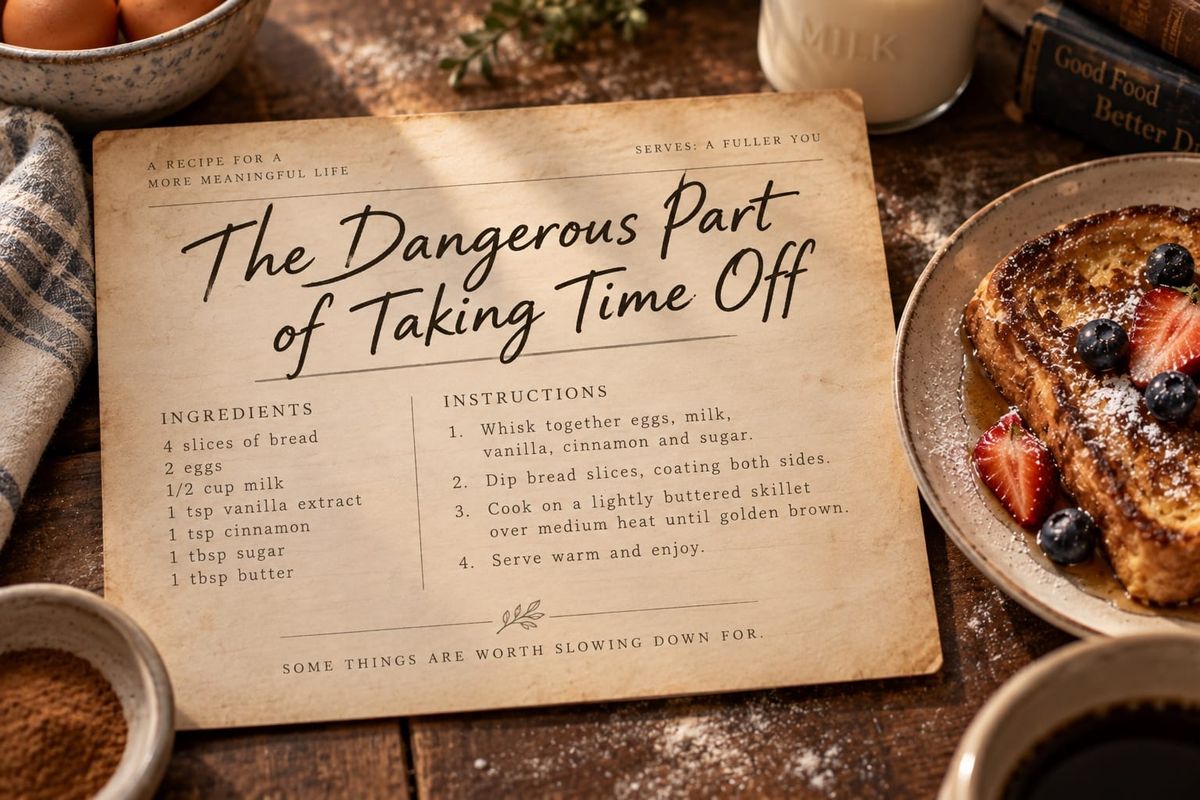
After we brought our new baby home from the hospital, I started getting up in the morning and making French toast for my wife.
It wasn’t particularly profound. She was recovering, I wanted to make sure she ate, and if some of the kids were awake, I made breakfast for them too.
But I noticed it.
Normally, mornings have somewhere to go.
There is work waiting. A deadline approaching. Something I need to answer. A project I should move forward. Even when I’m technically off, I’m usually learning something, building something, writing something, or finding another productive use for the time.
This time was different.
During the birth, the hospital stay, and the weeks afterward, I made a deliberate decision to take as much as I could off my wife’s plate. I fed her, did our laundry, helped with the baby, cooked, drove her around, and tried to keep the rest of the kids in some semblance of a schedule.
I wasn’t particularly productive by my normal definition.
I was also more present.
And I liked making her French toast.
Maybe Work Wasn’t the Problem
I’ve spent a lot of time thinking that someday I would like to stop working.
But that isn’t entirely accurate.
I enjoy working on new things. I like writing. I like learning. I like finding a problem I don’t understand, disappearing into it for a while, and coming back knowing considerably more than I did before.
I can happily spend weeks obsessed with a project and work ridiculous hours because I want to see where it goes.
What I don’t particularly enjoy is doing the same thing indefinitely.
I don’t want to prepare accounting work forever. I’d rather build something where other people eventually handle more of it. I don’t want every experiment or business idea to become another permanent job. If something can eventually operate without me, that is much more appealing.
And I especially don’t like deadlines.
That’s an awkward admission when some of your professional life exists in industries largely organized around them.
Taking real time away helped me separate those things.
I don’t necessarily want freedom from work.
I want freedom from having to work.
Those sound similar. I don’t think they are.
The Strange Economics of Taking Time Off
Travel has made me think about money before.
Trips to places like Washington, D.C. and Los Angeles reminded me how expensive life can become in major American cities. Other places I’ve traveled have felt surprisingly inexpensive by comparison.
But staying home and not working showed me something different.
Life itself can become expensive when you suddenly have time to participate in more of it.
We were shopping more. Going places. Doing things with the kids. Spending money on little activities that didn’t seem especially significant individually.
And I found myself watching money leave our accounts faster than I expected.
When we plan meals, cook at home, and don’t fill the schedule with things requiring paid admission, our money goes considerably further.
That isn’t a groundbreaking financial discovery. I’m an accountant. I understand how a budget works.
But understanding something in a spreadsheet and feeling it while you’re not producing income are different experiences.
I started noticing how much I rely on continuing to work.
That was uncomfortable.
Building Freedom Can Create More Work
Most of the projects I’ve started over the years have had some connection to freedom.
A business can create another source of income.
An investment can produce future income without requiring future labor.
A new skill can increase earning power.
Automation can make a business less dependent on me.
Even some of my more experimental projects eventually come back to the same question: Can I create something that continues producing value without requiring me to continually operate it?
The irony is that every new project also consumes time.
Some create deadlines.
Some create customers.
Some create another system that needs attention.
There is an opportunity cost to building freedom.
Sometimes the things we create so we can eventually work less cause us to work more now.
I’ve felt this with my accounting firm in particular. When I don’t have time to work on it, I feel like I’m missing opportunities to move it forward.
But if I’m precise about why I want to move it forward, part of the answer is so that someday I don’t have to keep moving it forward.
That’s a strange loop to find yourself in.
What Does Enough Look Like?
For me, there actually is a financial goal underneath all of this.
I want my expected annual investment income to exceed what it costs my family to live.
That’s the point where the equation changes.
I wouldn’t have to go to work tomorrow because the mortgage needs to be paid.
I wouldn’t have to keep saving for retirement because retirement would effectively already be funded.
I could still work.
I probably would.
I could write articles and books without wondering whether they justify the time I spend on them. I could become intensely interested in something for a few weeks, work ridiculous hours because I wanted to, and then leave it alone when I was finished.
I could travel.
I could spend more time helping my wife when she needs it.
And I could make French toast on a Tuesday morning without part of my brain reminding me about what I should already be doing.
The important part isn’t stopping.
It’s being able to.
Why a Safety Net Doesn’t Always Feel Safe
There’s an uncomfortable complication here.
I already have some financial security.
In a genuine emergency, there are resources I could draw from. There are ways I could restructure our lives. I wouldn’t immediately be unable to house or feed my family if I lost my job tomorrow.
But using those resources would come at the expense of the future I’ve spent years building toward.
That’s part of why a safety net doesn’t necessarily feel like freedom.
If I spend retirement assets keeping us afloat today, I’m solving one problem by reopening another one decades from now.
I’ve worked hard for a long time with the expectation that eventually the work would buy me freedom.
If I reached the end of that road only to discover that I’d spent the freedom somewhere along the way, I think I’d struggle not to resent it.
That feeling has probably become sharper after experiencing how quickly employment can become uncertain.
It reminded me that income can disappear for reasons that have little to do with whether you’re good at what you do.
Skills provide options.
They don’t provide certainty.
“Just Living” Isn’t Always Simple
There’s an easy answer to all of this: spend less.
And there is truth to that.
If it were just me, I could tolerate a remarkably modest lifestyle. I’d probably take considerably more career risks. I could disappear for a few months between jobs and not worry much about it.
But I have a family.
Providing for children changes the calculation.
There’s also a difference between imagining a simple life and actually raising a family inside modern expectations about what that life should look like.
We don’t particularly care about a lot of commercialized versions of fun. We don’t believe every kid needs every device or every activity available to them. We try to teach our kids that there are many different ways to construct a successful life.
But there are still housing costs.
Food.
Utilities.
Internet.
Transportation.
Education.
And, more importantly, the responsibility of giving your children enough stability that your personal experiment in simplicity doesn’t become their insecurity.
That responsibility makes freedom more expensive.
I’m not sure that’s necessarily bad.
It just changes the target.
Goals First
One thing I try to teach my kids is to start with the goal.
What kind of life do you actually want?
Then figure out what it takes to get there.
I teach them about SMART goals, education, college, trades, the military, careers and income. But none of those things are the destination.
They’re tools.
If one of my children grows up and decides they want a modest house, relatively few possessions, lots of time with their family, and a job that only requires three days a week, I don’t think they’ve failed to maximize their potential.
If that’s the life they genuinely want and they’ve figured out how to sustain it, they’ve succeeded.
Likewise, if another wants to build a company, work eighty-hour weeks and chase something enormous, that’s fine too.
The point is that they chose.
The optionality is the entire point.
Maybe That’s What Freedom Actually Is
Taking time away didn’t convince me that I hate working.
It did something more useful.
It showed me how different life feels when the next deadline isn’t sitting quietly in the room with me.
I like making things.
I like solving problems.
I like disappearing into an idea until I’m exhausted by it.
I’d probably continue doing those things even if nobody ever paid me again.
But I’d also like to be able to walk away from them.
I want to be there when my family needs me without mentally calculating what isn’t getting done somewhere else.
I want to be able to decide that, for a while, making breakfast is the most important thing I’m doing that morning.
I’ve spent much of my adult life working toward freedom.
Maybe the mistake would be assuming freedom is the absence of work.
I think it’s something simpler.
It’s reaching the point where work becomes a choice.