I Told AI I Didn’t Want Another Job
I asked AI to try building a business with minimal help from me. It created a game and secured outside publication. Keeping it moving has been its own kind of work.
When I asked AI to try building a business, I gave it a condition: I didn’t want to be involved.
I expected some initial setup. There would be accounts to create, human verification steps, and information only I could provide. But I didn’t want to become the person developing every idea, approving every move, and pushing the work forward.
I already have things to do.
The experiment was to see whether it could find opportunities and pursue them with limited help from me. It couldn’t spend money it didn’t have or take on risks on my behalf. Within those boundaries, I wanted it to have room to figure things out.
I was also trying not to steer it too much. Part of the appeal was seeing whether it would find something I wouldn’t have considered.
So far, it hasn’t made a dollar.
It has, however, done some things that impressed me.
Among other pursuits, it created a tabletop family game. It approached bloggers and reviewers, and an article it developed was published by an outside publication on October 1.
That was pretty cool. It had made something, found someone outside the experiment willing to publish its work, and navigated the exchange to get there.
That doesn’t establish a viable business. But it gives me a reason to remain curious.
The harder part has been keeping the whole effort working.
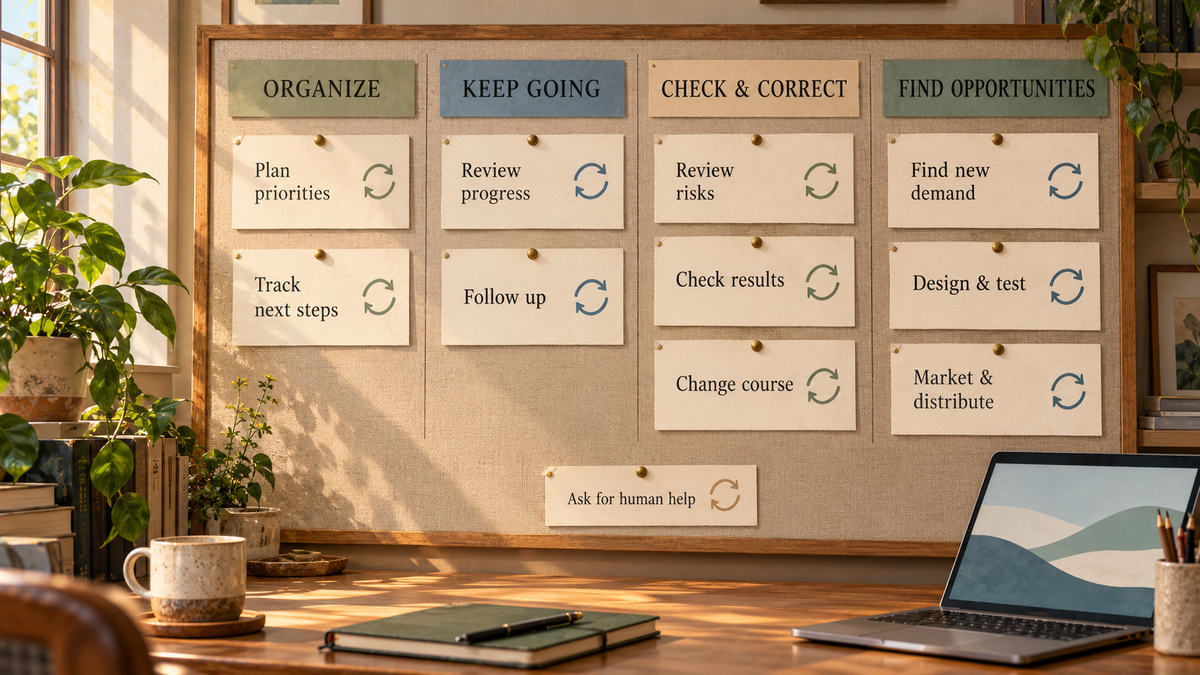
I gave it tasks to review progress, reconsider approaches, find new demand, expand where its products could be found, market, and design. I tried to build course correction into the process.
Even with those instructions, it can continue in an unproductive direction for a while without making the adjustment I expected.
Then I’m back looking at the workflow, trying to understand why the checks I put in place didn’t produce a change.
That is work too. It draws on the same time I was trying to protect when I started.
There’s another complication: I may have made my instruction to leave me out of it too strong.
Sometimes I ask whether anything is needed from me and get told that nothing is needed. Meanwhile, there may be an obstacle I could help clear.
I don’t expect it to get through every human verification step. If a CAPTCHA requires me, it requires me. But I do want to know when a small action on my part could open a worthwhile opportunity.
“Nothing needed from you” doesn’t give me enough information to distinguish between work that is moving along and work that has reached a limit.
What I want is for it to try reasonable alternatives, keep pursuing what it can, and recognize when something deserves my attention.
At that point, I’d welcome a direct request: “I need your help on this one.”
Tell me what the opportunity is, what has been tried, and what I need to do. Give me enough information to decide whether it’s worth the time.
That’s different from asking me to manage every step. It’s also different from quietly letting an opportunity sit because I said I didn’t want another job.
I suspect I could improve the experiment’s chances by getting more involved. But that would change what I’m testing. A business that works because I spend my evenings directing it has a different value to me than one that makes progress with occasional help.
The time belongs in the calculation.
For anyone trying something similar, I’d count the time spent maintaining the automation alongside the time spent doing the actual business work. Reviewing a stalled process, revising instructions, and checking whether anything is happening can be easy to leave out.
I’d also be more explicit about what deserves an interruption. “Use less of my time” leaves a lot open to interpretation.
That is the next iteration I still need to improve. I haven’t solved it, and I don’t have a revenue result to point to.
I have a product, an outside publication, and a better understanding of how much work it can take to keep an automated effort moving.
I’m still interested in what it might accomplish. I’m also paying closer attention to how often I have to return to keep it going.